Friday, 20 January 2023

Thinking Activity - The Waste Land

 This Blog is a response to the thinking activity on 'The Waste Land' given by professor Dr.Dilip Barad Sir.


T.S.Eliot:-


T.S. Eliot (1888-1965) was a highly influential modernist poet, playwright, and literary critic from the United States. He was born in St. Louis, Missouri and later moved to England, where he became a British citizen in 1927.


Eliot's early poetry, such as "The Love Song of J. Alfred Prufrock," is known for its intricate and allusive style, as well as its exploration of themes of alienation and modern urban life. He is also known for his use of fragmented, non-linear narrative and collage-like techniques.


In 1922, Eliot published "The Waste Land," which is widely considered to be one of the most important poems of the 20th century. The poem is a dense and complex work that explores themes of disillusionment, war, and the decay of modern civilization.


Eliot's work as a literary critic is also highly regarded, particularly his essays on the nature of poetry and the relationship between poetry and society. He is also known for his promotion of traditional literary forms and his criticism of modernist experimentation.


In 1948, Eliot was awarded the Nobel Prize in Literature "for his outstanding, pioneer contribution to present-day poetry." He died in London in 1965.


Introductory paragraphs on Waste Land :


1] The Burial Of the Dead


2] A Game Of Chess


3] The Fire Sermon


4] Death By Water 


5] What The Thunder Said.


The Waste Land is a long poem by T.S. Eliot, first published in 1922. The poem is considered to be one of the most important and influential works of modernist poetry. The Waste Land is a complex and dense work, drawing on a wide range of sources and references, including classical literature, world mythology, and contemporary events. The poem is divided into five sections, each of which explores a different theme or subject matter.


The first section, "The Burial of the Dead," introduces the themes of death and rebirth, and sets the stage for the rest of the poem. The second section, "A Game of Chess," explores the theme of sexual desire and its destructive consequences. The third section, "The Fire Sermon," deals with the theme of spiritual and moral decay, and the fourth section, "Death by Water," explores the theme of death and rebirth through the imagery of water. The final section, "What the Thunder Said," brings the various themes and images of the poem together in a powerful and apocalyptic vision.


Eliot's use of allusion, symbolism, and imagery in The Waste Land is central to its meaning and impact. The poem is known for its references to a wide variety of literary and historical sources, and for its use of symbols and imagery that are open to multiple interpretations. The Waste Land has been widely studied and analyzed, and is considered to be one of the most important and influential poems of the 20th century.


1) What are your views on the following image after reading 'The Waste Land'? Do you think that Eliot is regressive as compared to Nietzche's views? or Has Eliot achieved universality of thought by recalling mytho-historical answer to the contemporary malaise?


Yes , Eliot is regressive and progressive as compared to Nietzche's views.T.S. Eliot's views and literary works have been the subject of much critical debate and interpretation. While some have characterized him as regressive in comparison to the views of philosophers like Nietzsche, others argue that he achieved a universality of thought through his use of myth and historical allusions in his poetry.

In terms of his literary style, Eliot's use of allusions to classical literature, mythology, and other historical texts in his poetry is often seen as a way of grounding his work in a timeless, universal context. Some critics have interpreted his use of these references as a way of providing a deeper understanding of the contemporary world and its problems, rather than as a retreat from modernity.

On the other hand, some critics have argued that Eliot's work reflects a conservative, traditionalist perspective that is at odds with the views of philosophers like Nietzsche, who championed individualism and the rejection of traditional values. They have also criticized his work for promoting a patriarchal and elitist worldview.

Overall, the views of Eliot on these matters are complex and multifaceted, and it is important to consider different interpretations of his work.


2) Prior to the speech, Gustaf Hellström of the Swedish Academy made these remarks:

What are your views regarding these comments? Is it true that giving free vent to the repressed 'primitive instinct' lead us to happy and satisfied life? or do you agree with Eliot's view that 'salvation of man lies in the preservation of the cultural tradition'?

It is true that free vent to the repressed ‘primitive instincts’ lead us to happy and satisfied life’ but it will be upon the person that how is he or she giving that space to own self. Because it can create a problem or can say anarchy which Arnold used in his essay Culture and Anarchy. There we can see a chapter about. 'Doing as one like'.

     According to Eliot, if there is any kind of anarchy there we can find its solution from preserving culture or from tradition as well.    

        So when we talk about free vent it depends on the person that he will not misuse it otherwise it will create chaos. As Eliot says that we can peep into the back, to preserve culture it will help and balance the thing. 


3) Write about allusions to the Indian thoughts in 'The Waste Land'. (Where, How and Why are the Indian thoughts referred?)

"The Waste Land" by T.S. Eliot is a complex and dense poem that makes extensive use of allusions to a wide range of literary, mythological, and cultural sources. Among these, allusions to Indian thoughts and myths play a significant role in the poem's themes and imagery.

One of the most prominent references in the poem is to the Hindu god Shiva, who is associated with destruction and rejuvenation. The line "Shantih shantih shantih" at the end of the poem is a traditional Hindu blessing that roughly translates to "peace, peace, peace." This allusion serves to suggest the theme of destruction and rejuvenation in the poem. The poem portrays the desolation and barrenness of the modern world that is in need of spiritual rejuvenation.

There is also a reference to the legend of the Fisher King, a figure from Arthurian legend who is associated with the grail quest. In the poem, the Fisher King is a symbol of the barrenness and sterility of the modern world, which is in need of spiritual redemption.

Another reference is to the Upanishads, a collection of ancient Indian texts that contain spiritual and philosophical teachings.

Eliot also references the Hindu goddess Kali, who is associated with destruction and death. This allusion is used to convey the theme of the destructive nature of modern civilization, and the need for spiritual renewal.

In addition, the poem references the Indian epic poem the Ramayana, which tells the story of the prince Rama and his quest to rescue his wife Sita from the demon king Ravana. This allusion is used to convey the theme of the search for meaning and purpose in a world that is full of suffering and injustice.

Eliot also references the Indian concept of Maya, which is the idea that the physical world is an illusion and that true reality is spiritual. This idea is reflected in the poem's portrayal of a world that is empty and meaningless, suggesting that the material world is not enough to bring fulfilment and satisfaction.

In the poem, there are references to the Indian Epic poem the Mahabharata and the God Vishnu, who is associated with preservation and protection.

Another allusion to Indian thought in the poem is the use of the Buddhist concept of the "Wheel of Life" (Samsara), which represents the cycle of birth, death, and rebirth. This concept is reflected in the poem's portrayal of a world in which the past, present, and future are inextricably intertwined, and in which there is no escape from the cycle of suffering.

Overall, these allusions to Indian thoughts and myths serve to add depth and complexity to the poem's themes and imagery, and the search for redemption and to create a sense of universal relevance for the poem's message about the human condition in the modern industrialised world.


4) Is it possible to read 'The Waste Land' as a Pandemic Poem?

It is possible to interpret "The Waste Land" by T.S. Eliot as a pandemic poem, as it deals with themes of death, decay, and societal collapse that could be seen as paralleling the effects of a pandemic. However, it is important to note that the poem was written in 1922, before the widespread occurrence of pandemics in the 20th century, so any similarities may be coincidental. Additionally, the poem is widely considered to be a commentary on the societal and cultural upheaval of the post-World War I era, rather than a specific reference to a pandemic.


Photo:-1

Total Words :- 1537


Tuesday, 10 January 2023

Comedy of Menace

 Thinking Activity Comedy of Menace 


This Thinking Activity on For Comedy of Menace task was assigned by Yesha Bhatt Ma'am Department of English MKBU. In this task, we have to write down the Answer to Anyone one question,and I am writing on movie reviews.


It is the story based on the play by Harold Pinter of A man in his late 30s nammedStanley Webber (Robert Shaw) a mysterious and private man who takes up lodging in a rundown British seaside house. He rents an upstairs room from Mr. and Mrs. Bowles (Moultrie Kelsall, Dandy Nichols) who are quite odd themselves. One day two men dressed in black suits (Patrick Magee, Sydney Tafler) come to pay Stanley a visit. They know something about Stanley’s past and their presence frightens him to the extent that it causes him to have a nervous breakdown.


The film and sets look great, although things begin to get a bit claustrophobic as the action never moves from the main room or the kitchen, for the most part. Sydney Tafler & Patrick Magee are excellent as the two mysterious men, and you're really never sure of their purpose. 


Tuesday, 3 January 2023

Thinking Activity Trends and Movements

 This Blog is a response to the Thinking Activity on the Trends and Movements.This Blog is also about the 20th Century's Three movements Surrealism, Expressionism and Dadaism.


Surrealism:- 

Surrealism was an artistic, intellectual, and literary movement led by poet André Breton from 1924 through World War II. The Surrealists sought to overthrow the oppressive rules of modern society by demolishing its backbone of rational thought. To do so, they attempted to tap into the “superior reality” of the subconscious mind. “Completely against the tide,” said Breton, “in a violent reaction against the impoverishment and sterility of thought processes that resulted from centuries of rationalism, we turned toward the marvellous and advocated it unconditionally.


Surrealism is more than an artistic style—it’s an artistic movement.


Unlike other creative movements, which can be characterised by themes of imagery, colour choices, or techniques, defining Surrealist art is slightly harder to do.


Surrealist artists—like Joan Miró, Salvador Dalí, Pablo Picasso, or Michael Cheval, among many others—seek to explore the unconscious mind as a way of creating art, resulting in dreamlike, sometimes bizarre imagery across endless mediums. The core of Surrealism is a focus on illustrating the mind’s deepest thoughts automatically when they surface. This thought process for creating art is known as “automatism.”


"Lullaby of Uncle Magritte" (2016), Michael Cheval, Surrealism, Surrealist Art

“Lullaby of Uncle Magritte” (2016), Michael Cheval


Over the years, Surrealism has resulted in a fascinating collection of artwork ranging from mythical landscapes, to obscure sculpture arrangements, to intriguing depictions of people and animals.


Expressionism:-

Expressionism is a modernist movement, initially in poetry and painting, originating in Northern Europe around the beginning of the 20th century. Its typical trait is to present the world solely from a subjective perspective, distorting it radically for emotional effect in order to evoke moods or ideas.


Expressionism, In the visual arts, artistic style in which the artist depicts not objective reality but the subjective emotions that objects or events arouse. This aim is accomplished through the distortion and exaggeration of shape and the vivid or violent application of colour.

Expressionism emerged simultaneously in various cities across Germany as a response to a widespread anxiety about humanity's increasingly discordant relationship with the world and accompanying lost feelings of authenticity and spirituality. In part a reaction against Impressionism and academic art, Expressionism was inspired most heavily by the Symbolist currents in late-19th-century art. Vincent van Gogh, Edvard Munch, and James Ensor proved particularly influential to the Expressionists, encouraging the distortion of form and the deployment of strong colours to convey a variety of anxieties and yearnings.


The classic phase of the Expressionist movement lasted from approximately 1905 to 1920 and spread throughout Europe. Its example would later powerfully inform many individuals, and groups such as: Abstract Expressionism, Neo-Expressionism, and The School of London.


Dadaism:-


Dada (or Dadaism) is an avant-garde literary and artistic movement of the 20th Century, developed between 1916 and 1922, as a revolutionary and critical rejection of the brutality of the First World War.


The origins of the term are still unclear and there are various interpretations under consideration: Dada could derive from the non-sense onomatopoeic expression ‘dada’, one of the first words used in children’s language, recalling the absurd and playful roots of the movement.

Monday, 26 December 2022

Thinking Activity For Whom the Bell Tolls

Thinking Activity For Whom the Bell Tolls

 This Thinking Activity on For Whom the Bell Tolls task was assigned by Yesha Bhatt Ma'am Department of English MKBU. In this task, we have to write down the Answer to Anyone one question in the Novel.


Earnest Hemingway:-


Ernest Miller Hemingway (July 21, 1899 – July 2, 1961) was an American novelist, short-story writer, and journalist. His economical and understated style—which he termed the iceberg theory—had a strong influence on 20th-century fiction, while his adventurous lifestyle and public image brought him admiration from later generations. Hemingway produced most of his work between the mid-1920s and the mid-1950s, and he was awarded the 1954 Nobel Prize in Literature. He published seven novels, six short-story collections, and two nonfiction works. Three of his novels, four short-story collections, and three nonfiction works were published posthumously. Many of his works are considered classics of American literature.


Hemingway was raised in Oak Park, Illinois. After high school, he was a reporter for a few months for The Kansas City Star before leaving for the Italian Front to enlist as an ambulance driver in World War I. In 1918, he was seriously wounded and returned home. His wartime experiences formed the basis for his novel A Farewell to Arms (1929).Because he began as a writer of short stories, Baker believes Hemingway learned to "get the most from the least, how to prune language, how to multiply intensities and how to tell nothing but the truth in a way that allowed for telling more than the truth."Hemingway called his style the iceberg theory: the facts float above water; the supporting structure and symbolism operate out of sight.


The influential American literary icon became known for his straightforward prose and use of understatement. Hemingway, who tackled topics such as bullfighting and war in his work, also became famous for his own macho, hard-drinking persona.


Introduction of Novel:-

For Whom the Bell Tolls is a novel by Ernest Hemingway published in 1940. It tells the story of Robert Jordan, a young American volunteer attached to a Republican guerrilla unit during the Spanish Civil War. As a dynamiter, he is assigned to blow up a bridge during an attack on the city of Segovia.


It was published just after the end of the Spanish Civil War (1936–1939), whose general lines were well known at the time. It assumes the reader knows that the war was between the government of the Second Spanish Republic, which many foreigners went to Spain to help and which was supported by the Communist Soviet Union, and the Nationalist faction, which was supported by Nazi Germany and Fascist Italy. In 1940, the year the book was published, the United States had not yet entered the Second World War, which had begun on September 1, 1939, with Nazi Germany's invasion of Poland.

The book's title is taken from the metaphysical poet John Donne's series of meditations and prayers on health, pain, and sickness


Thursday, 15 December 2022

W.B.Yeats:Poems

 Thinking Activity : W.B.Yeats:Poems


This Blog is a response to the thinking activity on 'W.B.Yeats's poems' given by professor Dr. Dilip Barad Sir. 


William Butler Yeats[a] (13 June 1865 – 28 January 1939) was an Irish poet, dramatist, writer and one of the foremost figures of 20th-century literature. He was a driving force behind the Irish Literary Revival and became a pillar of the Irish literary establishment who helped to found the Abbey Theatre. In his later years he served two terms as a Senator of the Irish Free State.


A Protestant of Anglo-Irish descent, Yeats was born in Sandymount and was educated in Dublin and London and spent childhood holidays in County Sligo. He studied poetry from an early age, when he became fascinated by Irish legends and the occult. From 1900 his poetry grew more physical, realistic and politicised. He moved away from the transcendental beliefs of his youth, though he remained preoccupied with some elements including cyclical theories of life. He had become the chief playwright for the Irish Literary Theatre in 1897, and early on promoted younger poets such as Ezra Pound. Yeats was awarded the Nobel Prize in Literature in 1923. His major later works include 1928's The Tower and Words for Music Perhaps and Other Poems, published in 1932.


His Famous Works:-

1. Meru
2. Leda and the Swan
3. The Song of Wandering Aengus
4. He Wishes His Beloved Were Dead
5. When You Are Old
6. The Circus Animals Desertion
7. Lake Isle of Innisfree
8. The Sad Shepherd
9. The second coming
10. Easter 1916

1. The Second Coming

Turning and turning in the widening gyre
The falcon cannot hear the falconer;
Things fall apart; the centre cannot hold;
Mere anarchy is loosed upon the world,
The blood-dimmed tide is loosed, and everywhere
The ceremony of innocence is drowned;
The best lack all conviction, while the worst
Are full of passionate intensity.

Surely some revelation is at hand;
Surely the Second Coming is at hand.
The Second Coming! Hardly are those words out
When a vast image out of Spiritus Mundi
Troubles my sight: somewhere in sands of the desert
A shape with lion body and the head of a man,
A gaze blank and pitiless as the sun,
Is moving its slow thighs, while all about it
Reel shadows of the indignant desert birds.
The darkness drops again; but now I know
That twenty centuries of stony sleep
Were vexed to nightmare by a rocking cradle,
And what rough beast, its hour come round at last,
Slouches towards Bethlehem to be born?

"The Second Coming" is a poem written by Irish poet W. B. Yeats in 1919, first printed in The Dial in November 1920, and afterwards included in his 1921 collection of verses Michael Robartes and the Dancer. The poem uses Christian imagery regarding the Apocalypse and Second Coming to allegorically describe the atmosphere of post-war Europe. It is considered a major work of modernist poetry and has been reprinted in several collections, including The Norton Anthology of Modern Poetry. 
   
This poem is one of the most successful poems of William Butler Yeats. It is a non rhyming poem.It is a poem of Twenty Two lines expressing the opinion of the second incarnation.
 
When Yeats wrote ‘The Second Coming’ the First World War had just ended, memories of the Easter Rising in Ireland were still vivid and revolution had broken out in Russia. The world appeared to be in a state of flux and chaos.

"Turning and turning in the widening gyre   
The falcon cannot hear the falconer;
Things fall apart; the centre cannot hold;"

In the first stanza of the poem the poet explains the state of Complete disorder in Ireland. The poet says that time passes very fast and the wheel of time also moves fast. It changes rapidly. The poet further says that the Falcon does not hear the Falconer. Here Falcon is a small but to prey and falconer is a trainer of the bird who trains the Falcon in art of preying.or who gives the training of praying to the Falcon. But now Falcon is not in the control of his trainer.
  
"The Blood dimmed tide loosed"

During the First World War there was killing and death. There were many rivers of blood. Many innocent men died. His wife caught the virus and was very close to death. The highest death rates of the 1918–19 pandemic were among pregnant women—in some areas, there was an up to 70 percent death rate for these women.So here we found this poem as pandemic. It was a very terrible situation as we were faced because of the corona pandemic.This all symptoms we found in Infected people and also found in COVID -19 so people are different from both the pandemic but symptoms and situation are same. In another way we can say that the best people are confused about what to do and the worst not the worst but free - wanderers are free to do what they want to do and the poor people are facing so many problems due to lockdown. As we know, there was a rule that they weren't allowed to open shops and other things but they were sitting in the crowd and doing timepass which was strictly denied by the government.
  
"Surely some revelation is at hand;
Surely the second coming is at hand "

There is a terrible picture of Christ when he will come the second Time. There will be the body of a lion and the head of a man. There will be sand and the scorching rays of the Sun. The figure will move slowly in the darkness.
During the pandemic time, people became more religious,they started worshipping god more and more and expected some relief and help from God. referencing that people are believing that the second coming will surely happen and things will get better. The situation will again get back to normal.
  
There will be "A shape with lion body and the head of a man,
A gaze blank and pitiless as the sun." 
 And no sympathy in the eyes. The bad people will surely be punished.

The second coming however ends with hope
"rocking cradle".

It seems as if the poet is influenced by Hindu philosophy because the incarnation of the God 'Narsimha' resembles the imagination of the poem. As Jesus Christ took birth on the earth to save mankind. Like that the second incarnation of God also would appear on the earth to save mankind.

2. On Being Asked for a War Poem
I think it better that in times like these
A poet's mouth be silent, for in truth
We have no gift to set a statesman right;
He has had enough of meddling who can please
A young girl in the indolence of her youth,
Or an old man upon a winter’s night.
 

"On being asked for a War Poem" is a poem by William Butler Yeats written on February 6, 1915 in response to a request by Henry James that Yeats compose a political poem about World War I. Yeats changed the poem's title from "To a friend who has asked me to sign his manifesto to the neutral nations" to "A Reason for Keeping Silent" before sending it in a letter to James, which Yeats wrote at Coole Park on August 20, 1915. The poem was prefaced with a note stating: "It is the only thing I have written of the war or will write, so I hope it may not seem unfitting."The poem was first published in Edith Wharton's The Book of the Homeless in 1916 as "A Reason for Keeping Silent".When it was later reprinted in The Wild Swans at Coole, the title was changed to "On being asked for a War Poem".

It’s one of Yeats’s shortest well-known poems, comprising just six lines, and sets out why Yeats chooses not to write a ‘war poem’ for publication. The poem is written in iambic pentameter, rhymed abcabc. The final two lines are the only ones which might cause some real head-scratching from readers (and critics), but Yeats appears to be making an appeal to the broad readership that poetry (including his poetry, by 1915) enjoyed: young girls might enjoy his romantic verses about old Ireland, while an old man might enjoy the ballads.W B Yeats was lived in the time of world war because he know very well about world war. In this poem he describes his emotions and feelings.

"On Being Asked for a War Poem
I think it better that in times like these"


In the poem, the first stanza is about forthright and conversation for " times like these". When the poet writes of “a poet’s mouth” being silent, he is using a technique called metonymy. Like metaphor, metonymy substitutes one thing for another. Metaphor does this by contrasting different things but in metonymy, something closely related to something else is substituted.

"We have no gift to set a statesman right"

In this stanza This seems to say that poetry has no place in intervening in politics, and the poet has no role in making big statements about wars and what causes them.
One

In this stanza the poet says that A quick change in imagery and reference point, from the macrocosm to the microcosm, from the world of politics to the world of intimate acquaintances.this completes the scope of the poet’s influence. Does this mean that poetry is suited to everyday lessons and life? That the poet’s role is to appeal to beauty and wisdom, youth and age? These certainly seem narrower limits to the role of poetry than ‘setting statesmen right’.

Thank you…


Words:-1658
Images:- 1

Saturday, 10 December 2022

Thinking Activity - The Great Dictator

 This Blog is a response of thinking activity on 'Understanding the Zeitgeist of the 20th Century:From Modern Times to the era of Great Dictators(Movies)' given by our professor Dr. Dilip Barad Sir.


The Great Dictator:-


The Great Dictator is a 1940 American anti-war political satire black comedy film written, directed, produced, scored by, and starring British comedian Charlie Chaplin, following the tradition of many of his other films. Having been the only Hollywood filmmaker to continue to make silent films well into the period of sound films, Chaplin made this his first true sound film.
Charlie Chaplin:-


Sir Charles Spencer Chaplin Jr. KBE (16 April 1889 – 25 December 1977) was an English comic actor, filmmaker, and composer who rose to fame in the era of silent film. He became a worldwide icon through his screen persona, the Tramp, and is considered one of the film industry's most important figures. His career spanned more than 75 years, from childhood in the Victorian era until a year before his death in 1977, and encompassed both adulation and controversy.

Thinking Activity - The Modern Times Movie

 Thinking Activity: The Setting of 20th Century Literature


   This Blog is a response to the thinking activity on 'Understanding the Zeitgeist of the 20th Century:From Modern Times to the Era of Great Dictators(Movies)' given by our professor Dr. Dilip Barad Sir.


Frame study of Charlie Chaplin s movie 'The Modern Time '.


 The Modern Times :-


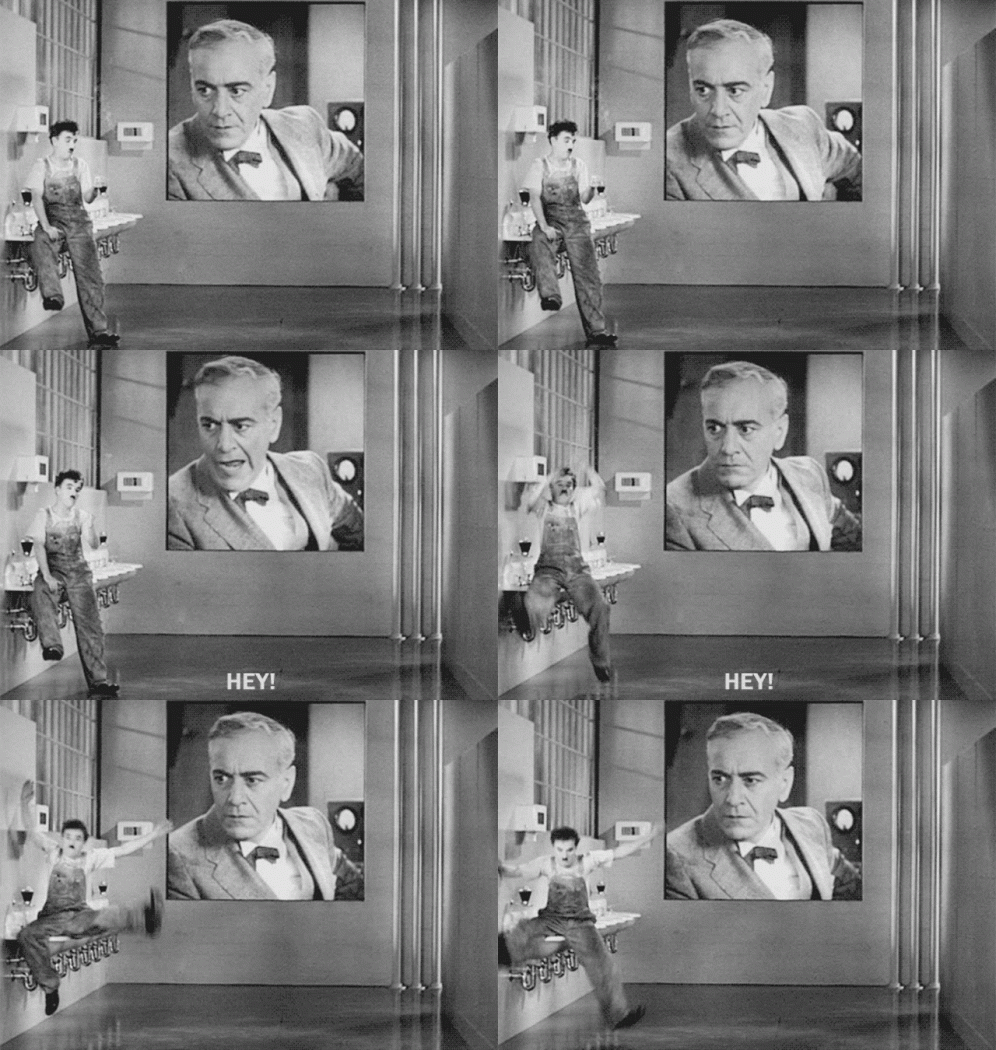
Modern Times is a 1936 American part-talkie satirical romantic black comedy film written and directed by Charlie Chaplin in which his iconic Little Tramp character struggles to survive in the modern, industrialised world. The film is a commentary on the desperate employment and financial conditions many people faced during the Great Depression — conditions created, in Chaplin's view, by the efficiencies of modern industrialization. The movie stars Chaplin, Paulette Goddard, Henry Bergman, Tiny Sandford and Chester Conklin. It is notable for being the last time that Chaplin portrayed the Tramp character and for being the first time Chaplin's voice is heard on film.
Chaplin's Modern Times criticises the growing industrial and mechanical nature of society through hyperbolic actions by the main character and varying reactions thereafter.

Directed by - Charlie Chaplin
Written by - Charlie Chaplin
Produced by - Charlie Chaplin 

Charlie Chaplin:-

Sir Charles Spencer Chaplin Jr. KBE (16 April 1889 – 25 December 1977) was an English comic actor, filmmaker, and composer who rose to fame in the era of silent film. He became a worldwide icon through his screen persona, the Tramp, and is considered one of the film industry's most important figures. His career spanned more than 75 years, from childhood in the Victorian era until a year before his death in 1977, and encompassed both adulation and controversy.

In this movie there is a very deep meaning  that we can see that people in the movie represent the labourers of the factory and also working class people. The bosses of the factories want to gain more and more profits and that's why they give more pressure on labourers for work and bosses treat their labour like machines.
 
Through the movie we can understand that the Industrial people or rich people are becoming more and more rich and on the other side poor people or common man are becoming more poor. 


Frame:-1


In this Frame the quote ' Modern Times' "A story of industry, of individual enterprise - humanity crusading in the pursuit of happiness." This quote shows us the condition of the workers and their scheduled work according to their master's order. It suggests the industrial revolution and after that machines took the place of man and people started working like machines. In the Movie Workers have to complete their tasks in a given time because they have too much value. Nowadays people's lives are controlled by watches. They planned everything according to the watch. This watch also shows what the 20th century's people were facing.


Frame:-2


This image is the opening scene of the movie. These above two frames are showing the similar situation of the sheeps and people of that time.This is concerned with the theme of dehumanisation. .In modern times , the extra excess of Industrialisation caused the dehumanisation of humankind. They are symbolised as sheep. Many people were roaming like sheep without direction.
  
Frame:-3


In this frame we can see that the director was looking at the workers. After looking on he also used to have them command. If we think we can realise that in today's time when workers are doing their work, the owner and the manager also look at them. They keep on looking at workers and keep them alerting that if they don't do it well then they have been fired. Here we can clearly see that technology, science, and machines are used to control life. while the main motive of the advancement in technology is to make the life of the people easier but here instead of giving freedom its controlling life.

Frame :-4


He working in machine industry.They all are working like machine as well.we can not see the freedom of workers.they became a slaves of machine even though machine made by a man.Charlie try to keep up with mind numbing repeatation of balts that must be tightenedas they make thire way to him on the conveyer belt.

Frame:-5

Exploitation of workers. Workers should not waste their time for lunch and they should continuously work. 


Frame:-6


Chaplin criticised the government who didn't allow people to ask for their right.When someone tried to break down the system that time political party took some actions against them to stop them and set an example of not doing and asking for right.And people felt fear and stopped doing that.

Frame:-7


This the female character of the movie.we can see that in those time people were jobless.so the girl became thief.she stole the bananas and feed his two sisters and father also because he was also jobless.she she has a dream to live life with facility.This dream became fulfill for a few time when Charlie got the job in the department store .


Frame:- 8


 The Hope Interestingly, the movie ends with dawn. The couple was walking on the path. In that scene mountains symbolise that now no matter which type of difficulties may come in our way, we are ready to face and overcome them and surely it will pay off and will bring changes in the modern times.

Words:-1000
GIF:-5
Photos:-6
Video:-1

Std 11 Grammar

Selection of responses (Based on language function) Select the most appropriate response.  1. (1) Uncle: How do you go to your school? Akash...